Why a Repeated Hobby Can Feel Easier to Return To
Why a repeated hobby feels easier to return to: familiar cues reduce decision-making, while small experiments help you notice what still sparks curiosity.
Why does a repeated hobby feel easier to return to after a busy day? A familiar activity can make it simpler to choose what to do, while a small experiment keeps the pastime from feeling stale. The trick is to use repetition as a way to explore, not as a rule for showing up.
Let a familiar hobby open the door to curiosity
Think of the hobby as a place to notice things, rather than a routine to complete. If you enjoy sketching, for instance, returning to the same subject can reveal details you missed before: the way a mug handle curves, or how a plant’s leaves overlap. You do not need a fresh idea every time to have something to discover.
Choose an activity that leaves room for observation. Gardening might mean noticing which corner of a windowsill gets the afternoon light; birdwatching might mean listening for calls before trying to identify them. The pleasure can come from paying attention, not from producing a polished result.
Pick one detail you are curious about, and let it guide the session.
Use a repeated hobby to explore one question
A small question gives a familiar pastime a new direction without making it feel like a different hobby. A knitter might wonder how a ribbed edge behaves beside a plain one. Someone learning guitar might listen for how a chord changes the mood of a tune they already know.
Keep the question open-ended and easy to answer through the activity itself. If it starts to feel like homework, make it simpler or leave it for another time.
Try questions such as:
- What changes if I draw this object from a lower viewpoint?
- Which herbs seem to thrive in the shadier part of the garden?
- How does this melody sound when I play it more softly?
- What textures can I notice on a walk along a familiar street?
Change the focus, not the whole pastime
When a hobby begins to feel repetitive, keep the activity and alter one element. A person who paints watercolours could focus on shadows rather than colour; a jigsaw fan could sort pieces by shape instead of by image. A narrow change gives curiosity somewhere to go without demanding a new set of materials or skills.
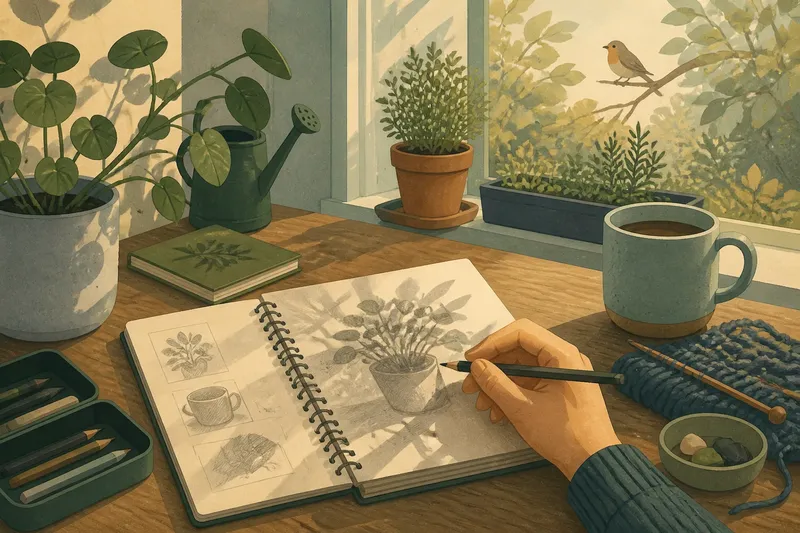
Say you usually sketch the same houseplant at your kitchen table, and you want to see it differently. Keep the pencil and sketchbook, but move the pot beside a window and draw only the pattern of light across its leaves. The resulting page may look less like a portrait of the whole plant and more like a study of its shadows; either way, you have explored a new angle while keeping the familiar activity.
Change one feature at a time, so you can tell what interests you.
Follow signs of curiosity rather than a fixed plan
Some sessions are absorbing; others are quiet or brief. Notice what draws your attention, and use that response to shape what happens next. If a particular flower catches your eye while gardening, spend a little time observing it instead of moving straight to the next task. If it does not hold your interest, turn to something else or stop.
That freedom matters. A pastime should not need to produce a result each time to be worthwhile, and changing direction is part of exploring.
Does a repeated hobby need a new challenge?
How can I tell whether I need more variety?
If you still enjoy the activity but find your attention wandering, try a small change to its subject, tool or setting. If the hobby itself no longer appeals, there is no need to keep adding challenges to make yourself continue.
What if I am a beginner?
Stay with materials and activities that feel approachable, and focus on noticing one thing rather than mastering a technique. Curiosity does not depend on experience or a finished result.
Can I repeat the same activity without changing anything?
Of course. Repeating a favourite song, tending the same plants or rereading a beloved book can be satisfying in itself. Change is an option, not a requirement.
Choose a small experiment that fits your interest
Before changing a hobby, check what you want from it and what you have available. These choices can help you decide whether to stay with the familiar version, try a modest variation or pause:
- If the activity still feels absorbing and you have no particular question to pursue, keep doing it as usual; if it feels flat, choose one detail to explore instead.
- If you are curious about a new technique but have suitable materials, try it on a small part of the project; if the materials are missing, use a familiar method or save the idea for later.
- If a new setting makes observation easier, move to that spot; if it makes the activity awkward to carry out, stay where you are and change the subject instead.
- If a question can be explored with the time and energy you have, follow it; if it demands more than you want to give, narrow the question or leave it unanswered.
- If changing several parts at once makes the hobby feel unfamiliar, return to the usual tools and alter only the subject; if one change already feels inviting, continue with that version.
- If you feel interested in continuing, follow the detail that caught your attention; if the activity feels like an obligation, put it aside without treating the pause as a failure.
A repeated hobby can make room for discovery without needing a grand plan. Keep the parts you enjoy, follow a question that genuinely interests you, and let the activity change—or stay the same—according to what feels inviting. That is one way a repeated hobby can stay worth returning to.